

Sessions with personal data masked using the Delete Profile or Deactivate Profile Nodes are excluded from the Conversations explorer.
- Via Cognigy
- Via Insights
- Select a Project.
- In the navigation menu, select Products > Insights.
- In the navigation menu of the Insights interface, select Conversations.
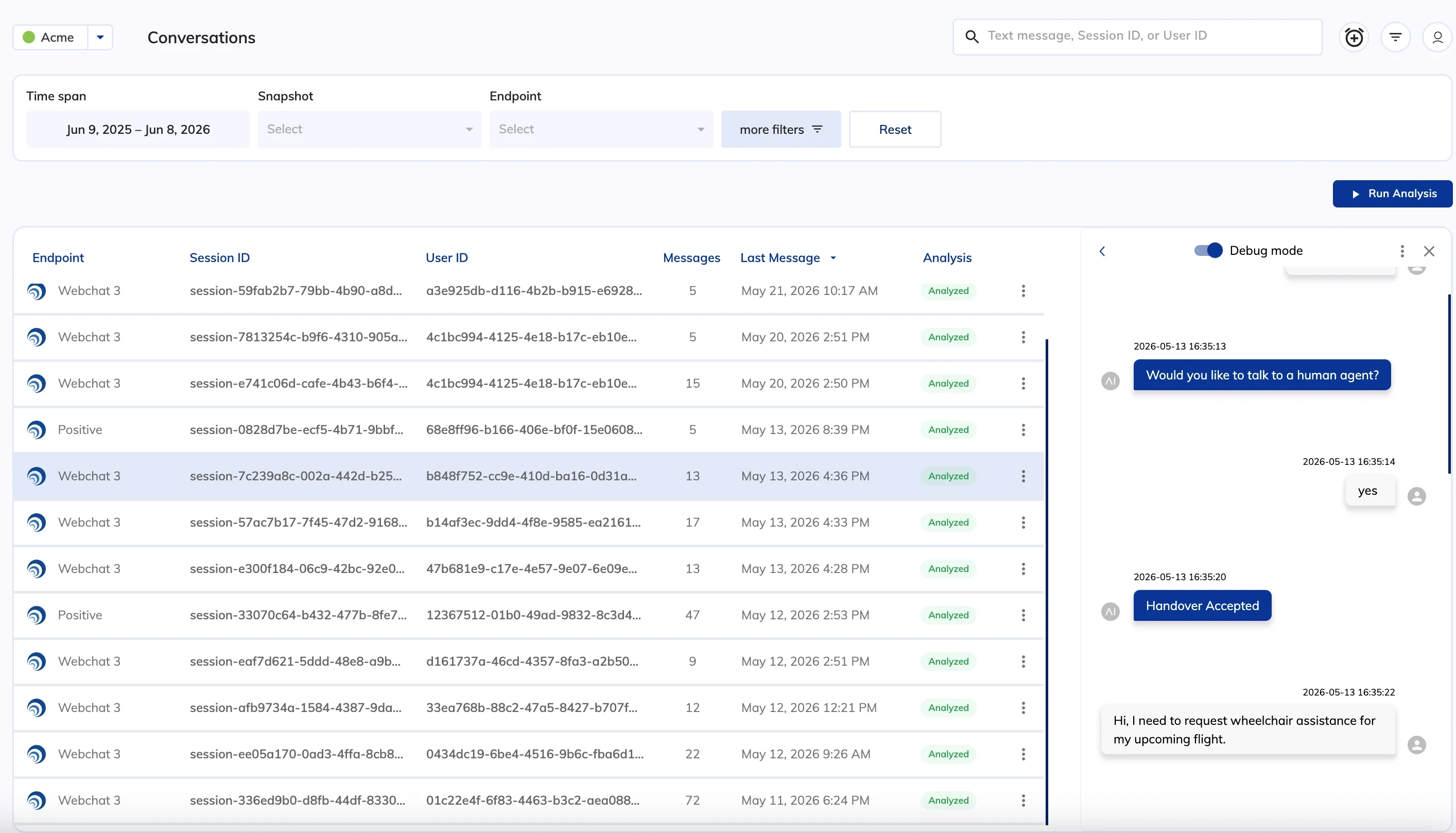
List of sessions
By default, the Conversations explorer displays a filtered list of sessions for the last month. The list of sessions has the following parameters:| Title | Description |
|---|---|
| Endpoint | The Endpoint handling the session. For example, Cognigy Webchat or the Interaction Panel. |
| Session ID | The unique ID for each session. To copy the Session ID, on the right side of the selected session row, click  |
| User ID | The unique ID for the end user. To copy the User ID, on the right side of the selected session row, click |
| Messages | The total number of messages within the specific session. |
| Last Message | The date and time when the last message was received within the session. |
| Analysis | Reflects whether the session has been analyzed by Conversation Analyzer. |
Sort sessions
Sessions can be sorted by theirSession ID, Messages, or Last Message parameters. To select a sorting parameter, hover over a column title and select the option you prefer:
- Click the up arrow

- Click the down arrow

Search for sessions
To find specific sessions, do the following:- In the upper-right corner of the Conversations page, locate the search field.
- In the search field, specify text messages (for more precise results, use keywords or phrases), Session ID, or User ID.
Filter sessions
There are several filters available to filter sessions. The filter bar, featuring global and local filters, is visible at the top of the page. Some filters are not immediately visible and require clicking more filters to be viewed and selected. You can filter sessions by using the following options: To hide the Filter Bar, click
Global filters
For more information, read the Global Filter documentation.Local filters
Local filters are unique to a specific explorer/report. You can use them to refine your research. To open the Local Filters selection, click more filters
The Message Rating, Goals, and Target Type filters are global filters. For more information, see Global filters. If you select AI Agents in the Target Type filter, the Message Rating, Goals, Tasks, Contains Step, and Flow filters are disabled.
Exclude filters
When you toggle the Negate option, all filters except the selected one will be analyzed. For example, if you select onlyWebchat
in the Endpoint filter and Negate, all data except the Webchat Endpoint will be analyzed.
Reset filters
To reset all filters, at the top of the page, click the Reset button on the right side of the filter panel. If the Reset button is not displayed, clickView session transcripts
Session transcripts are logged conversations between end users and agents. The Conversations explorer enables you to view session transcripts and analyze them to understand interactions between end users and agents better. To view a session transcript, select a session from the list on the Conversations page.Session transcript
Session transcripts display all individual messages between the end user and agent during their conversation. By selecting a session, the corresponding transcript will be displayed on the right side of the page. You can use the scroll bar to navigate through the messages in the Session Transcript window.The Session Transcript interface in the Conversations explorer is specifically designed for detailed analysis of past sessions, whereas the Interaction Panel is primarily used for testing and debugging Flows.
When you access a session transcript in the Conversations explorer, you may observe differences compared to the Interaction Panel. For example, the format and content of debug messages vary between these two tools.
Debug mode
Insights’ Debug mode is not fully equal to the Debug mode in the Interaction Panel documentation. Debug messages from Nodes (including Code Nodes and Debug Message Nodes) are only for immediate testing and can only be seen in the Interaction Panel. The Debug mode offers additional context for conversation messages, including:- Triggered Intent and its score
- Filled Slots
- User connection and disconnection events
- Voice event payloads
- xApp session details
Scenarios
You can create a scenario based on a session transcript. Scenarios allow you to simulate user interactions and test your Flows effectively.To create a scenario, an LLM model must exist on the LLMs page. By default, the LLM model marked as
default will be selected.- In the upper-right corner of the Session Transcript window, click
- Select Create Scenario. You will be redirected to the Simulator interface, where the Scenario will be created based on the selected transcript. The persona for the scenario will be generated from scratch. Click Create, then follow the instructions to run the simulation.
Playbooks
To create a Playbook from a transcript, do the following:- In the upper-right corner of the Session Transcript window, click
- Select one of the following options:
- Create Playbook — generate a Playbook to test your Flows.
- Create Playbook with Assertions — generate a Playbook and its Assertions, which are checks to ensure your Flows behave as expected during testing.
Download recordings and PCAP files
For sessions from voice calls, you can download the call recording and the PCAP file of the call. A PCAP file contains the network traffic of the call. For more information about both, see Recent calls in the Cognigy Voice documentation. To download a file, do the following:- In the upper-right corner of the Session Transcript window, click
- Select one of the following options:
- Download Recording to download the call recording.
- Download PCAP to download the PCAP file of the call.
- The session comes from a Voice call.
- You have permission to read the conversation history of the Project.
- Your environment includes agents. This is the same requirement as for the Target Type filter.
- For the recording, call recording is enabled in the Account or Application settings in Cognigy Voice.
Cognigy checks for a recording when you open the session. While the check runs, Download Recording is unavailable. If the call has no recording, the option stays unavailable, and hovering over it shows No recording for this call.
Open message-related flow
To check your Flow or to improve its configuration, the Conversations explorer provides the Open Flow context menu option. To switch from the Conversations explorer to the corresponding Flow in Cognigy, do the following:- In the left-side menu of the Insights interface, select Conversations.
- On the Conversations page, select a session from the list. The session transcript will appear in a separate window on the right side of the page.
- In the Session Transcript window, right-click a specific message and select Open Flow. The corresponding Flow in Cognigy appears.
Session transcript details
To get more session details, click
Session details
Call details
The Call Details section appears only for sessions from voice calls, and only if you have permission to read the conversation history of the Project. It appears below Session Details. The fields use the same terms as the Recent calls page in Cognigy Voice. If Cognigy has no value for a field, the field shows a hyphen (-). Calls that took place before Cognigy started storing these fields can show a hyphen for the call identity fields.Contact profile details
Evaluation details
To view the evaluation details for a session, clickDelete sessions
You can delete a session and its transcript by selecting the session from the list on the Conversations page and clickingIf you’ve migrated to the new Insights framework, there might be a delay between deleting the session transcript and the session itself. When you click the Delete Session Transcript button, the transcript is deleted first, and the session is deleted from the Conversations page about 10 minutes later.