Overview
Cognigy.AI is a modern, cloud-native software solution based on a scalable microservice architecture. This modern architecture allows
us to leverage the compute-power of multiple servers for a single software product. Instead of running a single executable on a single server,
we have decomposed Cognigy.AI into more than 30 separate executables. These smaller executables (hence the name microservice) despite being separated,
act as a single product — Cognigy.AI — by interacting with each other through network calls.
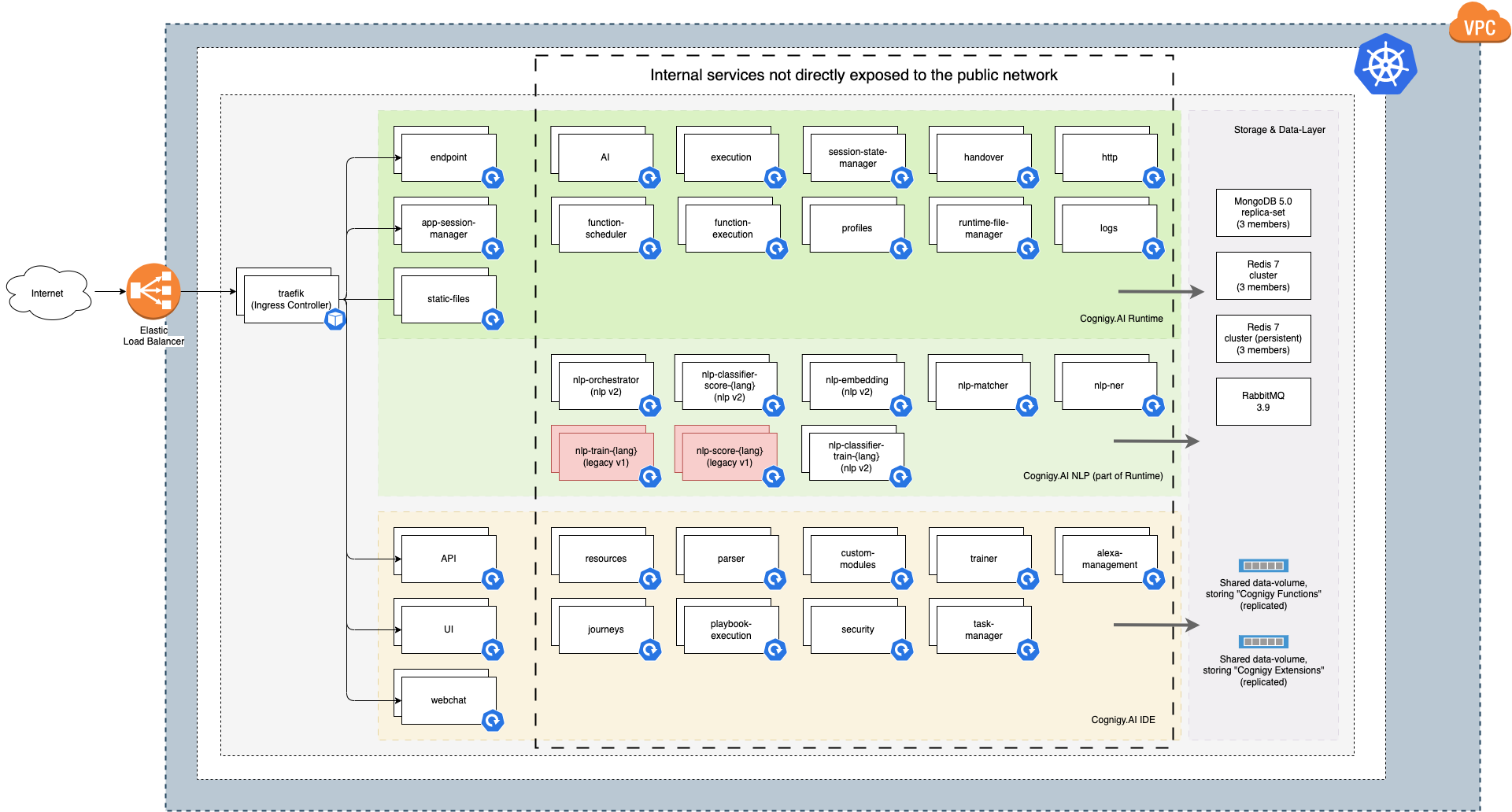
Each microservice runs as a containerized application on top of Kubernetes. Containers are a way of how processes can run in isolation
from each other and offer the ability to ship modern software products together with their dependencies, for instance, a runtime environment.
A program written in JavaScript might need a specific version of the Node.js runtime to function properly — containers allow packaging such
dependencies together with the actual application into one shippable unit. One of the more popular container runtimes and a set of other container-specific tools is Docker.
Managing a high number of moving parts — the microservices mentioned above — is quite a challenge and requires an additional software product
that is called a container orchestrator.
Kubernetes is such a container orchestrator dealing with the following tasks:
- Assigning containers to one of the available servers in the Kubernetes cluster respecting their individual hardware requirements and matching these against the available hardware on a server.
- Observing whether containers need to be restarted in case they crash.
- Updating containers to a newer version when a software update (for example, new version of Cognigy.AI) has been shipped,
- Testing whether containerized processes still react by sending readiness- and liveness-probes.
- Scaling microservices according to load-indicators such as CPU load, memory profile or custom metrics by starting additional copies of services.
Runtime & IDE
Cognigy.AI itself is a product offering different types of functionality:
While Cognigy Insights is actually also part of Cognigy.AI, it plays a smaller role when talking about the Cognigy.AI core product infrastructure. To learn more, read the Insights documentation.
IDE: Building your AI Agents
A service that allows you to create AI Agents and use all the components, such as Flows, Playbooks, Lexicons,
and Intents, is called the IDE (Integrated Development Environment) — a term often used in software development.
Once you are done with the first iteration of your AI Agent, a so-called Snapshot must be created to deploy your AI Agent into production.
A Snapshot is an immutable copy of your AI Agent containing all resources that make it up, such as your Flows, Lexicons, Intents, and Extensions.
Snapshots act as the connection to the second group of functionality: the Cognigy.AI Runtime.
The following table shows the most relevant microservices forming the IDE:
Runtime: Running your AI Agents
Our Runtime is optimized for performance & throughput. All microservices belonging to the runtime are stress-tested on a regular basis and can scale horizontally. Cognigy.AI’s runtime is a highly distributed system and can leverage huge amounts of hardware if given. We run performance tests for every release of Cognigy.AI in order to ensure that a new version is at least as fast & scalable as the last version.
The following table describes the responsibilities of key runtime microservices:
Last modified on June 15, 2026